1. Introduction & Overview
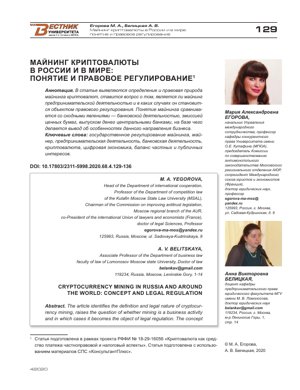
Cryptocurrency mining has emerged as a significant phenomenon in the digital economy, presenting complex challenges for legal systems worldwide. This analysis examines the conceptual foundations, legal nature, and regulatory approaches to mining, with particular focus on the Russian context and global comparative perspectives.
Key Statistics Context
Research Basis: RFBR Project No. 18-29-16056
Primary Focus: Legal classification of mining activities
Comparative Scope: Banking, securities issuance, central bank operations
2. Defining Cryptocurrency Mining
2.1 Conceptual Foundations
Mining represents the computational process of validating transactions and creating new blocks in a blockchain network. The Russian academic literature characterizes mining as "activity aimed at forming new elements to ensure the functioning of cryptocurrency platforms." This definition highlights the infrastructure-supporting role of mining beyond mere currency creation.
Critical distinction: Cryptocurrencies can be created outside mining frameworks (e.g., initial coin offerings), making mining specifically about network maintenance and validation rather than just currency generation.
2.2 Comparative Legal Analysis
The study compares mining with three established financial activities:
- Banking Activities: Unlike traditional banking with centralized control, mining operates through decentralized consensus mechanisms
- Securities Issuance: Mining rewards resemble securities in their value proposition but lack standardized regulatory frameworks
- Central Bank Currency Issuance: Mining decentralizes currency creation versus state-controlled monetary policy
3. Legal Nature & Classification
3.1 Entrepreneurial Activity Debate
The central legal question: Is mining entrepreneurial activity? The analysis identifies several determining factors:
- Systematic nature of operations
- Profit-seeking motivation
- Girmi da ci gaba ayyuka
- Matakin shiga kasuwa
Shawarar dokar Rasha (Bill No. 419059-7) ta ba da shawarar cewa hakar ma'adinai ya zama kasuwanci lokacin da amfani da makamashi ya wuce iyakokin da gwamnati ta kafa na tsawon watanni uku a jere.
3.2 Regulatory Thresholds
Energy consumption emerges as the primary regulatory trigger. This approach reflects practical enforcement considerations but raises questions about technological neutrality and innovation stifling.
Key Insight
The energy-based threshold represents a pragmatic but potentially problematic regulatory approach that may disproportionately affect smaller miners while allowing industrial-scale operations to dominate.
4. Global Regulatory Landscape
4.1 Russian Legislative Framework
Russia's approach, as reflected in proposed legislation, focuses on:
- Definitional clarity around mining activities
- Energy consumption thresholds for regulatory classification
- Taxation implications for mining operations
- Integration cum regulis oeconomicis existentibus
4.2 International Approaches
Belarus's Presidential Decree No. 8 offers an alternative model, defining mining separately from token creation and emphasizing blockchain maintenance functions. This contrasts with Russia's more integrated approach.
Global regulatory spectrum ranges from outright bans (China) to supportive frameworks (Switzerland, Singapore), with most jurisdictions adopting cautious, evolving approaches.
5. Technical & Economic Analysis
The technical foundation of mining involves cryptographic proof-of-work algorithms. The probability $P$ of a miner successfully creating a block can be expressed as:
$P = \frac{h}{D \cdot 2^{32}}$
where $h$ is the miner's hash rate and $D$ is the current network difficulty. This mathematical relationship underpins the competitive and resource-intensive nature of mining.
Experimental Results & Chart Description: While the PDF doesn't include specific experimental data, industry analyses (e.g., Cambridge Bitcoin Electricity Consumption Index) show mining energy consumption following predictable patterns based on hash rate and hardware efficiency. A typical chart would show exponential growth in network difficulty against linear improvements in hardware efficiency, creating increasing barriers to entry.
Analysis Framework: Regulatory Classification Matrix
Case Example: Classifying a mid-sized mining operation in Russia
- Step 1: Calculate average monthly energy consumption
- Step 2: Compare against government thresholds (e.g., 500 kW monthly limit)
- Step 3: Determine if exceeded for 3 consecutive months
- Step 4: If yes, classify as entrepreneurial activity with corresponding regulatory obligations
- Step 5: Apply relevant taxation, reporting, and compliance requirements
6. Core Insight & Analyst Perspective
Core Insight
The Russian regulatory approach represents a fundamental misunderstanding of mining's technological reality. By focusing on energy consumption as the primary regulatory trigger, authorities are treating a symptom rather than addressing the core legal questions about mining's nature. This is akin to regulating car manufacturing based on factory electricity usage rather than vehicle safety standards—it's measurable but irrelevant to the actual regulatory concerns.
Logical Flow
The paper correctly identifies the central tension: mining as infrastructure maintenance versus currency creation. However, it fails to follow this insight to its logical conclusion. If mining is primarily about network validation (as the Belarusian model recognizes), then regulation should focus on network security, transaction validation accuracy, and systemic risk—not energy consumption. The logical progression should be: define mining's core function → identify relevant public interests → design targeted regulations. Instead, we get energy thresholds—a bureaucratic convenience rather than principled regulation.
Strengths & Flaws
Strengths: The comparative analysis with banking and securities issuance is genuinely valuable. Drawing parallels with established financial activities provides crucial context for regulators. The recognition that cryptocurrencies can exist outside mining frameworks is also perceptive and important for regulatory design.
Critical Flaw: The acceptance of energy consumption as a legitimate regulatory threshold is intellectually bankrupt. As research from the University of Cambridge's Centre for Alternative Finance shows, Bitcoin mining's energy mix is increasingly renewable (estimated at 39% in 2022). Regulating based on total consumption rather than carbon intensity or energy source reflects outdated thinking. Furthermore, this approach creates perverse incentives—miners will seek jurisdictions with lax environmental standards, exactly the opposite of what responsible regulation should achieve.
Actionable Insights
1. Shift from energy to function-based regulation: Follow the Belarusian model of defining mining by its blockchain maintenance role, then regulate based on network security contributions.
2. Adopt a tiered approach: Differentiate between hobbyist, small-scale, and industrial mining with appropriate regulatory requirements for each tier.
3. Focus on what matters: Regulate mining pools (which control hash rate concentration) rather than individual miners. As the Ethereum Foundation's research shows, mining pool centralization represents the real systemic risk.
4. International coordination: Mining is inherently global—national regulations alone are insufficient. Russia should lead in developing CIS-wide standards rather than going it alone.
The paper's value lies in identifying the right questions, but its proposed solutions reflect regulatory timidity. True innovation in digital asset regulation requires moving beyond easy-to-measure proxies and confronting the actual technological and economic realities.
7. Future Applications & Directions
The evolution of mining regulation will likely follow several trajectories:
- Proof-of-Stake Transition: As major cryptocurrencies like Ethereum move to proof-of-stake, the energy consumption debate becomes largely irrelevant, necessitating completely new regulatory frameworks
- Green Mining Initiatives: Integration with renewable energy projects and carbon credit systems could transform mining from environmental liability to sustainability contributor
- Decentralized Regulation: Emerging concepts like decentralized autonomous organizations (DAOs) for self-regulation of mining pools
- Cross-border Regulatory Arbitrage: Miners will increasingly locate operations based on regulatory environments, creating competitive pressure for balanced approaches
- Integration with Traditional Finance: As mining operations scale and institutionalize, they will require interfaces with conventional banking and securities regulations
The most promising direction involves treating mining not as a standalone activity but as integral infrastructure for the broader digital economy, with regulations focused on systemic stability and innovation facilitation rather than restrictive control.
8. References
- Yegorova, M. A., & Belitskaya, A. V. (2020). Cryptocurrency Mining in Russia and Around the World: Concept and Legal Regulation. Journal of Russian Law, 4, 129-136.
- Presidential Decree No. 8 "On Development of Digital Economy" (2017). Republic of Belarus.
- Draft Federal Law No. 419059-7 "On Digital Financial Assets" (2018). Russian Federation.
- Cambridge Centre for Alternative Finance. (2022). Cambridge Bitcoin Electricity Consumption Index. University of Cambridge.
- Ethereum Foundation. (2021). Ethereum Mining Centralization Analysis. Research Report.
- Nakamoto, S. (2008). Bitcoin: A Peer-to-Peer Electronic Cash System. White Paper.
- World Bank. (2021). Global Cryptoasset Regulatory Landscape. Financial Technology Notes.
- Zohar, A. (2015). Bitcoin: Under the Hood. Communications of the ACM, 58(9), 104-113.