1. Introduction
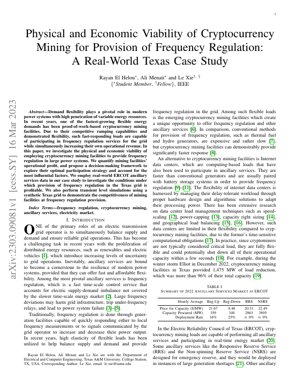
Modern power systems face significant challenges in balancing supply and demand due to the high penetration of variable renewable energy resources. Ancillary services, particularly frequency regulation, are critical for maintaining grid stability. This paper investigates a novel source of grid flexibility: proof-of-work-based cryptocurrency mining facilities. These facilities represent one of the fastest-growing flexible energy demands, characterized by competitive ramping capabilities and the ability to rapidly adjust their power consumption. The core research question is whether these facilities can be viably employed to provide frequency regulation services, thereby increasing their own operational revenue while supporting grid reliability. The study focuses on the Electric Reliability Council of Texas (ERCOT) grid as a real-world case study.
2. Methodology & Framework
The study employs a combined physical and economic analysis to assess viability.
2.1. Decision-Making Framework
A framework is proposed to guide mining facility operators in deciding optimal participation strategies in ancillary service markets, accounting for factors like electricity prices, cryptocurrency prices, and regulation market prices.
2.2. Economic Model
The operational profit of a mining facility is quantified. The model considers revenue from cryptocurrency mining (a function of hash rate and coin price) and revenue from providing frequency regulation services, balanced against the cost of electricity consumption.
2.3. Technical Feasibility
The paper assesses the physical capability of mining loads to follow fast regulation signals, highlighting their advantage over conventional thermal generators and even some data centers due to their lack of time-sensitive computational obligations.
3. Case Study: ERCOT Texas Grid
The theoretical framework is applied using real-world data from the ERCOT market.
ERCOT 2022 Ancillary Services Market Snapshot
- Reg-Up Capacity Price (Avg): $21.67/MW
- Reg-Down Capacity Price (Avg): $8.46/MW
- Reg-Up Capacity Procured: 359 MW
- Reg-Up Deployment Rate: 16%
3.1. Data & Market Context
Historical data on ERCOT ancillary service prices (Reg-Up, Reg-Down, Responsive Reserve Service - RRS, Non-Spinning Reserve Service - NSRS) and deployment rates are utilized. The paper notes the low deployment rates for RRS and NSRS (≈0%), contrasting with the active deployment of regulation services.
3.2. Profitability Analysis
The analysis identifies conditions under which providing frequency regulation in Texas is profitable for miners. It explores the trade-off between foregone mining revenue during load reduction and the compensation received from the grid operator.
3.3. Transient Simulation Results
Transient-level simulations on a synthetic Texas grid model demonstrate the competitiveness of mining facilities in providing fast frequency response, validating their technical capability to support grid stability during disturbances.
4. Key Insights & Comparative Analysis
5. Technical Details & Mathematical Formulation
The core economic model can be represented by a profit maximization function. The total profit $\Pi$ for a mining facility over a period is a function of revenue from mining and grid services, minus costs.
Profit Function:
$\Pi = R_{crypto} + R_{grid} - C_{electricity}$
Where:
- $R_{crypto} = f(P_{coin}, H(t), \eta)$ is the cryptocurrency mining revenue, dependent on coin price $P_{coin}$, the hash rate $H(t)$, and mining efficiency $\eta$.
- $R_{grid} = \int (\lambda_{reg}(t) \cdot P_{reg}(t)) \, dt$ is the revenue from providing regulation, where $\lambda_{reg}(t)$ is the regulation market price and $P_{reg}(t)$ is the power committed to regulation.
- $C_{electricity} = \int (\lambda_{elec}(t) \cdot P_{load}(t)) \, dt$ is the electricity cost, with $\lambda_{elec}(t)$ as the real-time electricity price and $P_{load}(t)$ as the total facility load.
The key decision variable is the allocation of the facility's power capacity $P_{max}$ between baseline mining load $P_{mine}$ and regulation capacity $P_{reg}$: $P_{max} \geq P_{mine} + P_{reg}$. During a regulation "Up" signal (grid needs less power), the miner must reduce load below $P_{mine}$, sacrificing mining revenue. The optimization finds the $P_{reg}$ that maximizes $\Pi$ given forecasted prices.
6. Analysis Framework: Example Case
Scenario: A 100 MW Bitcoin mining facility in ERCOT is evaluating participation in the Reg-Up service for a 4-hour period.
Inputs:
- Facility Power Capacity: 100 MW
- Avg. Electricity Price: $50/MWh
- Avg. Reg-Up Capacity Price: $22/MW
- Estimated Reg-Up Deployment Rate: 16%
- Mining Revenue per MWh Consumed: $65 (net of pool fees, based on a specific Bitcoin price and hash rate)
Decision Analysis (Simplified):
- Option A (Mining Only): Operate at 100 MW mining.
Revenue = 100 MW * 4h * $65/MWh = $26,000
Cost = 100 MW * 4h * $50/MWh = $20,000
Profit = $6,000 - Option B (Provide 20 MW Reg-Up): Set baseline mining at 80 MW, commit 20 MW to Reg-Up.
Mining Revenue = 80 MW * 4h * $65/MWh = $20,800
Reg-Up Capacity Revenue = 20 MW * $22/MW * 4h = $1,760
Reg-Up Deployment Energy Revenue (when called): 20 MW * 16% deployment * 4h * $[Energy Price during event] (assume $60/MWh) ≈ $76.80
Total Revenue ≈ $22,636.80
Electricity Cost: (80 MW baseline + potential deployment adjustments) ≈ 80 MW * 4h * $50/MWh = $16,000
Profit ≈ $6,636.80
Conclusion: In this simplified example, providing regulation increases profit by ~10.6%, demonstrating the potential economic benefit. The optimal commitment level (20 MW here) is found by solving the profit maximization function in Section 5.
7. Future Applications & Directions
- Beyond Frequency Regulation: Application to other ancillary services like voltage support, synthetic inertia, and ramping products in grids with very high renewable penetration.
- Hybrid Systems: Integration of mining facilities with on-site renewable generation (solar, wind) and/or battery storage to create resilient, grid-supportive "Energy-Data Hubs" that can island during outages.
- Proof-of-Stake & Other Consensus Mechanisms: Exploring the flexibility of data centers running Proof-of-Stake validation or AI training workloads, which may have different interruptibility profiles.
- Standardization & Market Design: Development of industry standards for communication, telemetry, and performance verification (similar to IEEE 1547 for inverters) to enable scalable participation of flexible computing loads.
- Sustainability-Linked Contracts: Coupling grid service participation with requirements for carbon-free energy procurement, turning a high-energy load into a driver for renewable investment, a concept explored by entities like the MIT Energy Initiative.
8. References
- Xie, L., et al. (2020). Wind Integration in Power Systems: Operational Challenges and Solutions. Proceedings of the IEEE.
- Kirby, B. J. (2007). Frequency Regulation Basics and Trends. Oak Ridge National Laboratory.
- ERCOT. (2023). 2022 Annual Report on Ancillary Services.
- Ghamkhari, M., & Mohsenian-Rad, H. (2013). Optimal Integration of Renewable Energy and Flexible Data Centers in Smart Grid. IEEE Transactions on Smart Grid.
- Goodkind, A. L., et al. (2020). Cryptocurrency Mining and its Environmental Impact. Energy Research & Social Science.
- National Renewable Energy Laboratory (NREL). (2021). Market Designs for High Penetrations of Distributed Energy Resources.
- Zhou, Y., et al. (2022). Economic Viability of Battery Storage for Frequency Regulation: A Review. Applied Energy.
- MIT Energy Initiative. (2022). Flexible Demand for Decarbonized Energy Systems.
Industry Analyst Commentary
Core Insight: This paper isn't just about demand response; it's a blueprint for monetizing grid parasitism. Cryptomining, often criticized as a pure energy sink, is reframed as a potential grid asset with superior response characteristics. The real insight is the creation of a dual-revenue stream model where miners arbitrage between crypto markets and grid service markets.
Logical Flow: The argument progresses cleanly: establish the grid's need for fast flexibility → identify cryptomining's unique technical attributes (speed, non-critical load) → build an economic model to prove profitability → validate with real-world ERCOT data. The use of Winter Storm Elliot (2022) as a natural experiment where miners provided 1,475 MW of load reduction is a powerful, real-world proof point.
Strengths & Flaws: The strength lies in its concrete, data-driven approach using actual market prices, moving beyond theoretical speculation. However, a major flaw is its narrow focus on economic viability for the miner, with less depth on the systemic impact for the grid. Does incentivizing this load create a perverse incentive for more energy-intensive mining? It also glosses over the regulatory and market design hurdles. ERCOT's unique energy-only market structure isn't directly transferable to capacity markets or regulated utilities, a point underscored by research from the National Renewable Energy Laboratory (NREL) on market design for distributed resources.
Actionable Insights: For grid operators: Develop fast-responding demand response product specifications that cryptominers can qualify for. For miners: Use the paper's decision framework to build a real-time bidding algorithm. For policymakers: Consider creating a separate asset class or performance requirements for "Ultra-Fast Demand Response" to properly value and integrate this resource, while potentially implementing sustainability criteria to avoid locking in high carbon-footprint loads. The model here is analogous to the role of battery storage in frequency regulation, as analyzed in studies like the "Economic viability of battery storage for grid applications", but with different cost and sustainability dynamics.