1. Introduction
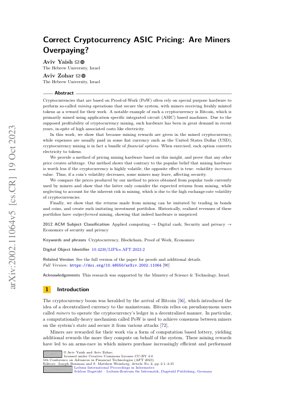
Proof-of-Work (PoW) cryptocurrencies like Bitcoin rely on specialized hardware (ASICs) for mining operations that secure the network, with miners receiving newly minted tokens as rewards. The perceived profitability of mining has driven intense demand for this hardware, despite high operational costs like electricity. This paper challenges conventional wisdom on how to value this hardware, proposing that mining is fundamentally a bundle of financial options rather than a simple revenue-generating asset.
2. Core Concepts & Problem Statement
The paper identifies a critical disconnect in mining economics: rewards are received in a volatile cryptocurrency (e.g., BTC), while operational expenses (electricity, hardware) are paid in flat currency (e.g., USD). This creates a complex financial position not captured by simple return-on-investment calculations.
2.1 The Mining as an Option Bundle
The core insight is that a mining machine represents a bundle of real options. Each time a miner decides to turn on the machine, they are effectively exercising an option to convert electricity (a cost in USD) into cryptocurrency tokens. The miner will only "exercise" this option when the value of the tokens expected to be mined exceeds the cost of electricity. This optionality has intrinsic value.
2.2 Flaws in Naïve Hashprice Models
Popular mining calculators rely on a metric called hashprice (Definition 1), which calculates expected profit per unit of computation (e.g., per terahash). The critical flaw is that these models typically assume a constant or expected future cryptocurrency price, completely ignoring the risk and volatility associated with the reward. They treat mining as a simple annuity, not as a risky, option-laden asset.
3. The Options-Based Pricing Model
The authors develop a formal pricing model based on options theory to correctly value ASIC miners.
3.1 Mathematical Formulation
The value of a mining machine can be framed as the sum of a series of European call options. For a machine with hashrate $H$, power consumption $P$, and electricity cost $C$ per kWh, the profit for a single period (e.g., a day) if mining is:
$\pi(t) = H \cdot R(t) \cdot S(t) - P \cdot 24 \cdot C$
Where $R(t)$ is the mining reward per unit hash at time $t$, and $S(t)$ is the spot price of the cryptocurrency. The miner operates only if $\pi(t) > 0$. This payoff is identical to that of a call option on the mined tokens with a strike price equal to the electricity cost. Therefore, the total machine value $V$ over its lifetime $T$ is:
$V = \sum_{t=1}^{T} e^{-rt} \cdot \mathbb{E}^{Q}[\max(H \cdot R(t) \cdot S(t) - P \cdot 24 \cdot C, 0)]$
where $\mathbb{E}^{Q}$ is the expectation under the risk-neutral measure, and $r$ is the risk-free rate. This shifts valuation from a simple discounted cash flow model to an options pricing problem.
3.2 Volatility as Value Driver
A counter-intuitive but crucial result of the model is that higher cryptocurrency price volatility increases the value of the mining hardware. In options pricing (e.g., in the Black-Scholes model), option value increases with the volatility of the underlying asset ($\sigma$). Since the mining machine is a bundle of options, its value is positively correlated with the future volatility of the cryptocurrency's price. This directly contradicts the naive view that volatility is purely a risk that decreases asset value.
4. Empirical Analysis & Results
The paper validates its model through empirical comparison and replication strategies.
4.1 Comparison with Popular Mining Calculators
The authors compare the prices suggested by their options-based model with those from mainstream mining profitability calculators. The analysis shows that traditional calculators systematically undervalue mining hardware because they fail to price the embedded optionality and the value of volatility. They only account for expected returns, neglecting the "insurance" value of being able to shut down during unfavorable conditions.
4.2 Replicating Portfolio Performance
To prove mispricing, the authors construct a replicating portfolio using financial instruments that mimic the payoff of a mining machine. This portfolio might consist of a risk-free bond and a position in the cryptocurrency itself (or derivatives), dynamically adjusted to reflect the optionality. Their historical back-testing shows that the returns from this passive financial portfolio have outperformed the actual returns from mining. This is a classic sign of arbitrage: if the hardware were correctly priced, the returns should be equal, accounting for risk. The fact that they are not suggests miners are overpaying for ASICs.
5. Implications for Network Security
The model has profound implications for blockchain security:
- Volatility-Security Link: If a coin's price volatility decreases (e.g., as it matures), the options-based value of mining hardware falls. This could lead to a rational exodus of miners, reducing the network's hashrate and potentially compromising its security against 51% attacks, a concern echoed in studies like "On the Instability of Bitcoin Without the Block Reward" (Carlsten et al., 2016).
- Miner Behavior: The model formally justifies observed miner behavior like seasonal migration and strategic shutdowns—they are rationally exercising their options.
- Subsidy Phase-Out: As block rewards diminish over time (e.g., Bitcoin halvings), transaction fees will become more important. The options framework can be extended to value hardware based on fee revenue, which is likely even more volatile.
6. Critical Analysis & Expert Perspective
Core Insight: The market for Bitcoin ASICs is fundamentally broken, valuing hardware like a predictable tractor when it's actually a bundle of exotic financial derivatives. Miners, often technologists, are paying a premium for operational complexity while ignoring the cheaper, pure-financial replicas of their payoff available on any major exchange.
Logical Flow: Yaish and Zohar brilliantly reframe the miner's decision from "Will I profit on average?" to "Do I have the right, but not the obligation, to profit?" This shift from expected value to contingent claim is the entire ballgame. It explains why mining persists during seeming price slumps—the option to mine retains value even if its immediate exercise doesn't. Their replicating portfolio is the kill shot: if you can synthetically create mining returns with bonds and spot BTC, and it performs better, then the physical hardware has a negative "convenience yield." You're paying extra for the hassle.
Strengths & Flaws: The strength is the elegance and empirical backing of the arbitrage argument. It's a compelling "proof by replication." The flaw, common in financial models, is the reliance on several key assumptions: a liquid and efficient market for the underlying crypto, the ability to continuously adjust the replicating portfolio (which has transaction costs), and the stability of network parameters like hashrate and difficulty. A sudden, unexpected hashrate surge changes the reward $R(t)$ for everyone, a correlated risk not fully captured by a portfolio of just BTC and bonds. This is akin to the model risk highlighted in the seminal work on Long-Term Capital Management.
Actionable Insights: 1) For Miners: Before buying that next S21, run the options model. The fair price is likely lower than the manufacturer's quote. Consider allocating capital to the replicating portfolio instead. 2) For Investors: The mining sector's equity may be systematically mispriced. Look for companies whose valuation relies on naive hashprice models—they could be value traps. 3) For Protocol Designers: Recognize that PoW security is not just a function of price, but of price volatility. Designing for more stable fee markets or incorporating volatility-dependent parameters, as suggested in some Ethereum research, could be crucial for long-term security.
7. Technical Framework & Case Example
Analysis Framework Example (Non-Code):
Consider evaluating an Antminer S19 XP (140 TH/s, 3010W) for a 2-year lifespan. A standard calculator might:
- Assume a constant future Bitcoin price (e.g., $60,000).
- Estimate daily BTC earnings based on current network difficulty.
- Subtract daily electricity cost at $0.05/kWh.
- Discount the 2-year profit stream at a high, arbitrary "risk" discount rate (e.g., 15%).
- Arrive at a "fair" hardware price of $4,000.
The Options-Based Framework would:
- Model the Underlying: Use a stochastic model (e.g., Geometric Brownian Motion) for Bitcoin's future price, calibrated with its implied volatility from derivatives markets (e.g., 70% annualized).
- Define the Option Series: Treat each day as a separate European call option. The "strike price" for Day t is the USD cost of electricity for that day: $Strike_t = 3.01 kW * 24h * $0.05/kWh = $3.61$.
- Determine the Payoff Asset: The quantity of the underlying asset for each option is the expected BTC mined that day, which itself depends on the evolving network hashrate. This adds a layer of complexity, modeling difficulty adjustments.
- Price the Bundle: Use numerical methods (like Monte Carlo simulation) to value the sum of these 730 daily options under the risk-neutral measure. This price will be higher than the naive model's $4,000 because it incorporates the positive value of volatility. The model might output a fair value of $5,500.
- Arbitrage Check: Construct the replicating portfolio. For simplicity, say the option bundle's "delta" (sensitivity to BTC price) is equivalent to holding 0.1 BTC. The replicating strategy involves holding $5,500 in a combination of 0.1 BTC and a risk-free bond, rebalancing daily according to the option's changing delta. Historical simulation would test if this portfolio's returns exceeded simply buying the S19 XP and mining.
8. Future Applications & Research Directions
- Decentralized Finance (DeFi) Products: The replicating portfolio concept can be productized. We could see the emergence of "synthetic mining" tokens or vaults that use options and spot holdings to generate a yield stream mimicking a specific ASIC's output, democratizing access to mining economics without hardware.
- Advanced Risk Management for Mining Farms: Large-scale operations can use this framework to hedge their exposure more precisely. Instead of just selling future BTC production, they can structure collars, straddles, and other option strategies around their expected hash output, optimizing for the optionality they possess.
- Valuation of Proof-of-Stake (PoS) Validators: While PoS doesn't have an electricity conversion option, it has other forms of optionality (e.g., the option to restake, to switch validation duties, the option value of slashing risk). Applying real options theory to PoS node valuation is a logical next step.
- Merger & Acquisition (M&A) Analysis: This framework provides a more robust tool for valuing mining companies during acquisitions, moving beyond simplistic price-to-earnings metrics based on current hashprice.
- Protocol Design Innovation: Could new consensus mechanisms be designed where the security budget explicitly accounts for and harnesses this optionality value? Research could explore volatility-adjusted reward mechanisms.
9. References
- Yaish, A., & Zohar, A. (2023). Correct Cryptocurrency ASIC Pricing: Are Miners Overpaying? In Proceedings of the 5th Conference on Advances in Financial Technologies (AFT 2023). https://doi.org/10.4230/LIPIcs.AFT.2023.2
- Full Version: Yaish, A., & Zohar, A. (2020). Correct Cryptocurrency ASIC Pricing: Are Miners Overpaying? arXiv preprint arXiv:2002.11064. https://arxiv.org/abs/2002.11064
- Nakamoto, S. (2008). Bitcoin: A Peer-to-Peer Electronic Cash System.
- Carlsten, M., Kalodner, H., Weinberg, S. M., & Narayanan, A. (2016). On the Instability of Bitcoin Without the Block Reward. In Proceedings of the 2016 ACM SIGSAC Conference on Computer and Communications Security.
- Hull, J. C. (2018). Options, Futures, and Other Derivatives (10th ed.). Pearson. (For foundational options theory).
- Easley, D., O'Hara, M., & Basu, S. (2019). From Mining to Markets: The Evolution of Bitcoin Transaction Fees. Journal of Financial Economics.