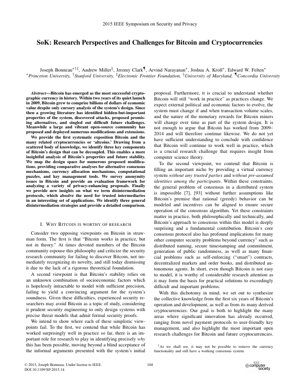
1. Why Bitcoin is Worthy of Research
The paper opens by addressing two opposing, simplistic viewpoints on Bitcoin. The first is the pragmatic view that "Bitcoin works in practice, but not in theory," often held by its community. The second is the academic dismissal that Bitcoin's stability relies on intractable socio-economic factors, making formal analysis futile. The authors argue both views are flawed. While Bitcoin has demonstrated surprising resilience, understanding why it works and whether it will continue to do so under evolving conditions (scaling, changing miner incentives, external pressures) is a crucial computer science challenge. Conversely, Bitcoin's achievement of consensus in a trustless, permissionless setting—a problem classically considered impossible—is a fundamental contribution with implications far beyond currency, including distributed naming, timestamping, and smart contracts. Therefore, despite modeling difficulties, Bitcoin warrants serious research attention.
2. Decoupling Bitcoin's Core Components
A key contribution of this paper is the systematic decoupling of Bitcoin's monolithic design into three core, independent components. This framework enables clearer analysis and innovation.
2.1 Consensus Mechanism (Nakamoto Consensus)
This is the protocol for achieving agreement on a single transaction history in a peer-to-peer network without a central authority. It relies on Proof-of-Work and the longest-chain rule.
2.2 Currency Allocation & Monetary Policy
This defines how new bitcoins are created and distributed (e.g., to miners as block rewards) and the total supply schedule (capped at 21 million).
2.3 Computational Puzzle (Proof-of-Work)
This is the specific cryptographic hash puzzle (SHA-256) used to secure the consensus mechanism by imposing a cost on block creation. It is separable from the consensus logic itself.
3. Comparative Analysis of Proposed Modifications
The paper surveys the expansive design space opened by decoupling Bitcoin's components.
3.1 Alternative Consensus Mechanisms
The analysis covers proposals like Proof-of-Stake (PoS), where validation rights are based on coin ownership, Delegated Proof-of-Stake (DPoS), and Byzantine Fault Tolerance (BFT)-based variants. The trade-offs between energy efficiency, security assumptions ("nothing at stake" problem in PoS), and decentralization are mapped.
3.2 Privacy-Enhancing Proposals & Anonymity
Bitcoin's pseudonymity is evaluated as weak. The paper provides a framework for analyzing privacy solutions like CoinJoin (transaction mixing), Confidential Transactions (hiding amounts), and Zero-Knowledge Proof systems (e.g., zk-SNARKs used in Zcash), balancing anonymity, scalability, and auditability.
4. Disintermediation Protocols & Strategies
The paper explores how blockchain concepts can remove trusted intermediaries (disintermediation) in applications like smart contracts and decentralized markets.
4.1 Three General Disintermediation Strategies
- Locking and unlocking scripts: Using Bitcoin's script system to enforce contract conditions.
- Replicated state machines: Platforms like Ethereum that execute code across all nodes.
- Sidechains and pegged assets: Allowing assets to move between different blockchains.
4.2 Detailed Strategy Comparison
The strategies are compared across dimensions such as complexity, flexibility, security guarantees, and scalability. The paper notes the inherent tension between creating powerful, Turing-complete scripting languages and maintaining system security and predictability.
5. Key Insights & Research Challenges
Core Insight
Bitcoin's success is not magic; it's a composable system whose stability relies on a precarious but functional alignment of cryptography, game theory, and distributed systems principles.
Major Challenge
Formalizing the security model of "Nakamoto Consensus" under realistic, adaptive adversary models and changing economic conditions remains an open problem.
Design Space
Decoupling components reveals a vast design space for altcoins, but innovation in one dimension (e.g., consensus) often introduces new vulnerabilities in another (e.g., incentive alignment).
6. Original Analysis & Expert Perspective
Core Insight: This paper isn't just a survey; it's a foundational deconstruction manual for the cryptocurrency ecosystem. Its greatest value lies in the "decoupling" framework (Section 2), which shattered the early monolithic view of Bitcoin. Before this, most analysis treated Bitcoin as a black box—either a revolutionary success or a dubious scam. Bonneau et al. provided the intellectual toolkit to see it as a set of interchangeable, often conflicting, subsystems: consensus, monetary policy, and compute. This is akin to the contribution of the OSI model to networking; it created a common language for critique and innovation. We've seen this play out directly: Ethereum kept Proof-of-Work but changed the consensus incentives and added a state machine; later, it decoupled further by moving to Proof-of-Stake (The Merge), validating the paper's modular perspective.
Logical Flow: The paper's logic is surgical. It first legitimizes Bitcoin as a serious object of study by dismantling both naive boosterism and academic dismissal. It then performs the core decoupling operation, establishing the analytical axes. With this framework in place, surveying modifications (Section 3) and disintermediation strategies (Section 4) becomes a structured comparative exercise rather than a list of features. The flow moves from what Bitcoin is, to how we can think about its parts, to what we can build by recombining those parts differently.
Strengths & Flaws: Its primary strength is this enduring analytical framework, which remains relevant a decade later. The privacy evaluation framework is also prescient, foreshadowing the trade-offs in today's privacy coins and regulatory debates. However, its main flaw, visible in hindsight, is underestimating the scaling challenge's centrality. The paper touches on transaction volume scaling but doesn't place the scalability trilemma (decentralization, security, scalability) at the heart of its design space analysis. This trilemma, later articulated by researchers like Vitalik Buterin, has become the dominant lens for evaluating consensus and layer-2 innovations (e.g., rollups, sidechains). Furthermore, while it mentions "socioeconomic factors," the 2017-2024 era has shown that miner/extractor value (MEV), regulatory arbitrage, and decentralized finance (DeFi) composability risks are socioeconomic forces that fundamentally reshape the security and utility landscape in ways the 2015 paper couldn't fully anticipate.
Actionable Insights: For builders and investors, this paper is a checklist for evaluating any new cryptocurrency or protocol. Question 1: How does it decouple the three core components? A project that doesn't clearly define these is red-flagged. Question 2: On which axis of the design space (consensus, privacy, disintermediation) is it primarily innovating, and what known trade-offs from this survey does it encounter? For example, a new Proof-of-Stake chain must have a compelling answer to the "long-range attack" and validator centralization problems outlined in the comparative analysis. Question 3: Does its disintermediation strategy (if any) increase systemic complexity and attack surface faster than it delivers utility? The paper warns against the "replicated state machine" complexity, a warning heeded by the slow, careful development of Ethereum's EVM versus the myriad exploits on more rushed chains. In summary, treat this paper not as history, but as the enduring grammar for reading the white paper of tomorrow.
7. Technical Details & Mathematical Framework
The security of Bitcoin's Proof-of-Work relies on the computational difficulty of inverting a cryptographic hash function. The probability of an attacker overtaking the honest chain is modeled as a Poisson race. Let $p$ be the probability the honest chain finds the next block, $q$ be the probability the attacker finds the next block ($p + q = 1$), and $z$ be the number of blocks the attacker is behind. The probability the attacker ever catches up from $z$ blocks behind is approximated by:
\[ P_{\text{attack}} \approx \begin{cases} 1 & \text{if } q > p \\\\ (q/p)^z & \text{if } q \le p \end{cases} \]
This shows the security grows exponentially with the lead $z$ when the attacker has less than 50% of the hash rate ($q < p$). This model, while simplified, underpins the "6-confirmation" rule for high-value transactions.
Chart Description (Conceptual): A graph plotting $P_{\text{attack}}$ (y-axis) against the Attacker's Hash Power $q$ (x-axis), for different values of $z$ (confirmations). The curves show a sharp drop as $q$ falls below 0.5, and for a fixed $q<0.5$, $P_{\text{attack}}$ plunges exponentially as $z$ increases from 1 to 6. This visually demonstrates the diminishing return on attack probability with more confirmations.
8. Analysis Framework & Conceptual Case Study
Case Study: Evaluating a Privacy-Centric Altcoin (e.g., early Zcash/Monero concepts)
Using the paper's framework, we can deconstruct a proposed privacy coin:
- Consensus: Likely retains Proof-of-Work (initially) but may change the hashing algorithm (e.g., Equihash for ASIC resistance).
- Currency Allocation: May have a different emission curve (e.g., tail emission vs. hard cap) to fund ongoing development or miner incentives.
- Computational Puzzle: Changed from SHA-256 to a memory-hard algorithm to alter miner centralization dynamics.
- Privacy Enhancement: Implements a specific strategy from Section 3.2, e.g., ring signatures (Monero) or zk-SNARKs (Zcash). This choice directly impacts scalability (zk-SNARKs require trusted setup and heavy computation) and auditability (a fully shielded pool is opaque).
- Disintermediation Strategy: May be limited if complex smart contracts are incompatible with the chosen privacy scheme.
This structured analysis immediately highlights trade-offs: superior privacy may come at the cost of verification speed, regulatory scrutiny, and complexity bugs (as seen in real-world vulnerabilities in these systems).
9. Future Applications & Research Directions
The paper's identified challenges have evolved into today's core research frontiers:
- Scalability & Layer-2 Protocols: The need for scaling beyond on-chain transactions has led to active research on Rollups (Optimistic, ZK), state channels, and sidechains, directly addressing the transaction volume concern raised in Section 1.
- Formal Verification & Security: The call for more precise models has spurred work on formally verifying blockchain consensus protocols (e.g., using model checkers like TLA+) and smart contracts (e.g., with tools like Certora, Foundry).
- Cross-Chain Interoperability: The disintermediation strategy of "sidechains" has expanded into complex interoperability research for cross-chain messaging and asset transfers (e.g., IBC, LayerZero).
- Post-Quantum Cryptography: The security of all cryptographic components (signatures, hashes, zk-proofs) against quantum adversaries is a critical long-term direction.
- Decentralized Identity & Governance: Applying blockchain consensus to problems like naming and autonomous organizations (DAOs) remains an active area, grappling with the socio-technical challenges hinted at in the paper.
10. References
- Nakamoto, S. (2008). Bitcoin: A Peer-to-Peer Electronic Cash System.
- Buterin, V., et al. (2014). Ethereum: A Next-Generation Smart Contract and Decentralized Application Platform. Ethereum Whitepaper.
- Lamport, L., Shostak, R., & Pease, M. (1982). The Byzantine Generals Problem. ACM Transactions on Programming Languages and Systems (TOPLAS).
- Ben-Sasson, E., et al. (2014). Zerocash: Decentralized Anonymous Payments from Bitcoin. IEEE Symposium on Security and Privacy.
- King, S., & Nadal, S. (2012). PPCoin: Peer-to-Peer Crypto-Currency with Proof-of-Stake.
- Garay, J., Kiayias, A., & Leonardos, N. (2015). The Bitcoin Backbone Protocol: Analysis and Applications. EUROCRYPT.
- Narayanan, A., Bonneau, J., Felten, E., Miller, A., & Goldfeder, S. (2016). Bitcoin and Cryptocurrency Technologies: A Comprehensive Introduction. Princeton University Press.